The short version
- Most runners run every run at the same so-so effort. That's the gray zone.
- Run easy most days (Zone 2), hard on purpose once a week (Zone 4), and keep a little speed in your legs.
- We set zones with heart rate reserve (the Karvonen method): 50, 60, 70, 80, and 90%.
- About 80% easy, 20% hard.
- New to this? Set up your watch first: How to Set Up Heart Rate Zones on Your Watch.
Zone 2. Threshold. VO2 max. Lactate. Red line.
Clear as mud?
If you've spent any time on running Instagram, you've heard all of it. And if you're like most runners, you've tuned it out.
I get it. These are the things I hear every week:
I don't have a heart rate monitor.
I can't run that slow.
Zones are for nerds.
I just like to run.
These are fair. I don't blame anyone for thinking this way. For a long time, I was the guy blasting heart rate training. As long as it feels easy, it's easy.
I was wrong. Very wrong.
Here's the problem. Most runners do almost every run at the same effort. Not easy. Not hard. Somewhere in the middle. It feels productive. It's mostly junk.
Meet the Toughness Coefficient
There's an inverse relationship between mental toughness and your ability to run easy. I call it the toughness coefficient.
The tougher you are, the less likely your "easy" run is actually easy.
You finish a 6 mile run and tell me it was easy. Your Strava says your heart rate averaged 170.
That's not easy. That's the gray zone.
This is my most provocative take: tough runners have underdeveloped aerobic systems. If your ego doesn't take a hit from that, tell me your secret. It took me 16 years to figure it out.
The good news? Zones fix this. And you only need to understand a few of them.
The Zones I Actually Use
There are a dozen zone systems out there. Five zones, seven zones, color-coded zones. Here's the one I coach with.
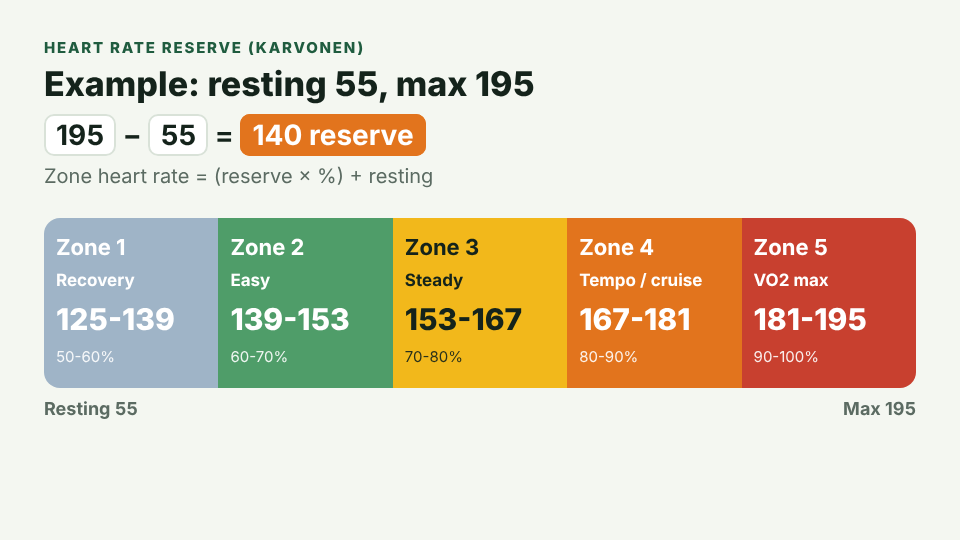
We set zones with heart rate reserve. That's the space between your resting heart rate and your max. The example numbers below are for a runner with a resting heart rate of 55 and a max of 195.
| Zone | Effort | Talk test | % of heart rate reserve | Example (rest 55, max 195) | How often |
|---|---|---|---|---|---|
| Zone 1: Recovery | 1 to 2 out of 10 | Full conversation | 50 to 60% | 125 to 139 | Off days, walks |
| Zone 2: Aerobic foundation | 3 to 4 out of 10 | Full sentences | 60 to 70% | 139 to 153 | About 80% of your week |
| Zone 3: Steady (or the gray zone) | 5 to 6 out of 10 | Short sentences | 70 to 80% | 153 to 167 | Only on purpose |
| Zone 4: Threshold (tempo) | 6 to 7 out of 10 | A few words | 80 to 90% | 167 to 181 | Once a week |
| Zone 5: Red line (VO2 max) | 9 out of 10 | Forget it | 90 to 100% | 181 to 195 | Every few weeks, once you're ready |
| Speed | Relaxed fast to all-out | Doesn't matter | Doesn't matter | Doesn't matter | 1 to 2 times a week |
Zone 1: Recovery
Walking counts. An easy bike ride counts. This is the stuff you do on your off days to feel better tomorrow.
Zone 2: Your Aerobic Foundation
This is where the magic happens, and it only happens if you actually run easy.
Zone 2 builds the aerobic engine that supports everything else. More mitochondria, better recovery, fewer injuries. You don't feel it working. That's the point.
The catch: it takes time. Aim for runs of at least 45 minutes, ideally over an hour. And your Zone 2 pace will probably be way slower than you think.
Zone 3: The Gray Zone (Unless You Mean It)
This is where most runners live without knowing it. Too hard to be easy, too easy to be a real workout.
It feels like hard work, so it feels like progress. But you're too tired to nail your real workouts and not easy enough to recover. I'd rather you run a little too easy than a little too hard. Too easy still stacks benefits. A little too hard is junk.
There's one exception: running in Zone 3 on purpose, for a set amount of time. That's a steady state run, and it's a different thing entirely.
Threshold: The Perfect Tempo
Comfortably hard. Controlled. You should finish feeling like you could have done one more rep.
Tempo runs aren't supposed to hurt. They're supposed to work. Most runners blow them by starting too fast, so I build them as a progression:
- 10 minutes at the top of Zone 3 (moderate)
- 15 minutes in the low part of Zone 4 (moderately hard)
- 10 to 20 minutes in the high part of Zone 4 (hard)
More on this in Tempo Runs Explained and Cruise Intervals Explained.
Leave your ego at home. Pace doesn't matter here. Heart rate does.
The Red Line: VO2 Max
This is the pace you could hold for about 10 to 12 minutes, max. Your heart rate climbs into Zone 5 and everything starts to hurt.
Here's the thing: most runners can only live at the red line for about three minutes. I call them Kickers. A small number, maybe 5%, can hold it for five. Those are Grinders.
Odds are, you're a Kicker. So train like one. Start your reps controlled and finish faster than you started.
Want the full breakdown? Read VO2 Max Training Explained.
Speed: The Zone Nobody Talks About
Strides. Short hill sprints. 10 to 20 seconds, full recovery. Heart rate doesn't matter here.
I coach sprinters, so I'm biased. But every runner needs this. The faster your top speed, the easier your race pace feels. That's called speed reserve.
You don't get slower because you get fitter. You get slower when you stop training speed.
How to Find Your Numbers
We use heart rate reserve, also called the Karvonen method. It uses two numbers instead of one, so your zones fit you.
1. Find your resting heart rate. Your watch already tracks it. No watch? Count your pulse for 30 seconds right after you wake up, then double it.
2. Find your max heart rate. Use the highest number you've seen at the end of a hard race. If you don't have one, 220 minus your age is a rough starting point.
3. Do the math.
Zone heart rate = ((max - resting) x percent) + resting
Our runner with a resting heart rate of 55 and a max of 195 has a reserve of 140. The bottom of Zone 4 is (140 x 0.80) + 55 = 167.
4. Put it on your watch. Garmin is not set up this way out of the box. It starts with zones based on your max heart rate, so you have to switch it to %HRR. Apple Watch already uses heart rate reserve. Step-by-step pictures for both are in How to Set Up Heart Rate Zones on Your Watch.
Want the long version? I made a video on the Karvonen method on my YouTube channel, Boring Running.
Get a chest strap. Your watch probably has a heart rate sensor, but wrist sensors aren't the most accurate. I use a Coospo chest strap. It's under $30 and does exactly what it needs to do.
Set a Zone 2 alarm. Have your watch beep any time you drift above Zone 2. Let that be my voice in your head saying "Run slower!"
Don't panic about your pace. My marathon PR is 2:43, about 6:15 per mile. You'd think my Zone 2 pace would be close to 7:00. Wrong. Try 10 minutes per mile. Crawling.
Compare your Zone 2 pace to yourself, not to anyone else. You might start at 10:00 per mile and, months later, be cruising at 7:00 at the same heart rate. That's the engine getting bigger.
Remember it's not perfect. Heat, sleep, stress, and fueling all move your heart rate around. That's fine. Heart rate is still a better guide than feel for most of us, because it's honest when you aren't.
Brand New to Running?
If you're just starting out, or coming back after a long break, staying in Zone 2 can feel impossible without basically walking.
So walk. Give yourself two numbers:
- Your cap: the top of Zone 2. For our example runner, that's about 153.
- Your baseline: the bottom of Zone 1. For our example runner, that's about 125.
Run until you hit your cap. Walk until you're back near your baseline. Repeat. Over a few weeks, the running parts get longer and longer until you're running the whole time. Even the walking parts count. Walking in Zone 2 still builds your engine.
Putting It Together: The 80/20 Rule
Here's the simplest rule in running: about 80% of your training easy, about 20% hard. Almost nothing in the middle.
This isn't something I made up. Researchers who study elite endurance athletes keep finding the same pattern. Most of their training is easy, a small chunk is hard, and very little lands in between. It's called polarized training.
And 80% means all of it. Not just your miles. If you cross train, that counts too.
You still have to grind. Just grind sparingly. Grind 20% of the time and your workouts get way better, because you show up to them fresh.
What a Week Looks Like
Here's a simple week for someone running five days. It's built around our club runs, so the hard day and the long day are the ones you do with us.
| Day | Run | Zone |
|---|---|---|
| Monday | Easy run + 4 to 6 strides, then strength | Zone 2 + speed |
| Tuesday | Easy run | Zone 2 |
| Wednesday | Tempo with Eastside Run Club at Garver, 5:30 PM | Threshold |
| Thursday | Strength, or a walk | Zone 1 |
| Friday | Easy run + strides | Zone 2 + speed |
| Saturday | Long run with the club at Olbrich, 9:00 AM | Zone 2 |
| Sunday | Off | Rest |
Once you've got a few months of this under you, swap a tempo for a red line session every few weeks. Something like 4 to 6 x 800 meters, starting controlled and finishing faster. Like a Kicker.
Does It Actually Work?
When I trained for my sub-2:45 marathon, this is what it looked like:
- About 50 miles a week, mostly Zone 2
- One threshold workout every week
- Strides twice a week
- A long run one week, a marathon-specific workout the next
- A red line session every two or three weeks
- Strength two to three times a week
That's it. No hero workouts. No gray zone grinding.
It was one of the most fun training blocks I've ever done. Boring running works.
What About Kids?
Keep it simple. Kids don't need heart rate monitors, and they definitely don't need zone charts.
They need the talk test:
- Can you tell your buddy about your day? That's easy. Most of the run should feel like this.
- Can you only get out a few words? That's a workout. Save it for Wednesday.
- Can you not talk at all? That's a race, or a sprint. Short and fun.
And let them sprint. Strides, races to the next light pole, tag. Kids are built for short bursts, and speed is the zone that keeps running fun.
So You Think You're Tough?
Prove it.
For a tough runner, grinding is easy. Running slow is the hard part. Your ego is going to scream at you. Don't listen.
Embrace boring. Run slow most days, run hard on purpose once a week, and keep a little speed in your legs. Stack those bricks for a few months and see what happens.
You won't get hurt as often. Getting out of bed won't hurt. And you'll dominate your workouts.
Want help with the easy part? Come run with us. Saturday long runs at Olbrich are Zone 2 with friends, and Wednesday tempos at Garver are the perfect threshold workout. Or build a free training plan that does the math for you.
No one runs alone.
Further Reading
If you want to go deeper on any one zone, start here:
- How to Set Up Heart Rate Zones on Your Watch
- How to Do a Workout on Your Watch
- Steady State Running
- Tempo Runs Explained
- Cruise Intervals Explained
- VO2 Max Training Explained
- Is Zone 2 Training Really for Everyone?
- Tough Athletes Benefit the Most from Heart Rate Training
- How to Run the Perfect Tempo
- You're Not a Grinder. You're a Kicker.
- Can Cross Country Make You a Faster Sprinter?
Sources
- Stöggl and Sperlich (2015), The training intensity distribution among well-trained and elite endurance athletes, Frontiers in Physiology
- Esteve-Lanao, Foster, Seiler and Lucia (2007), Impact of training intensity distribution on performance in endurance athletes, Journal of Strength and Conditioning Research
- Garmin: Setting your heart rate zones